Tim said this about my talk at [un]prompted, then had me on Live with Tim O’Reilly to give the encore and take 40 minutes of audience questions. The full recording is now on YouTube.
tl;dr AI made finding bugs cheap. Judging each one, patching it, and shipping it still takes a human. Patch the Planet, the effort I started with OpenAI, gives open-source projects agents to do that work at machine speed.
Clint Gibler, Peter Steinberger, and I talk through Patch the Planet (on X).
On Monday we launched Patch the Planet with OpenAI’s Daybreak team. Here’s what I told WIRED:
Patch the Planet is an internet-scale effort to help open-source software get ahead of AI bug-hunting tools.
How it started
Since February, Trail of Bits has been one of the firms reviewing what Claude Mythos finds for Anthropic’s coordinated disclosure program. We reproduce each bug by hand, judge its severity, write the fix, and coordinate disclosure with the maintainer. Mythos has surfaced more than 23,000 candidate findings, and Anthropic calls the human review the rate-limiting step. We script the mechanical step with tools like fp-check, which sorts real bugs from false positives. That was the easy part. The hard part is what a finding means: Anthropic’s own data shows Claude’s severity rating matches the reviewing firm’s only 59% of the time, because the model can’t see a project’s threat model. Hundreds of reports in, the time goes to deciding what each bug means and what to do about it.
By [un]prompted in March, the bug-finding tools were already excellent. Open-source frameworks like raptor turn a coding model into a capable security agent, and talk after talk pushed them further. One of those talks was mine. But better finding was never the hard part, so I ran the other way.
When The Verge interviewed me in April about AI and script kiddies, I told them what I’d been seeing: “There’s a tidal wave coming. You can see it.”
Trail of Bits has spent years securing the infrastructure the internet runs on: we’ve audited OpenSSL, Kubernetes, PyPI, and Homebrew, among others. That track record is why maintainers who had written off AI tools after a flood of slop still gave us a hearing. They’re the maintainers I set out to help.
In May, I took the idea for a dedicated program around the industry. The scope was big enough to go straight to OpenAI’s executives: Dane Stuckey, their CISO, backed it, and president Greg Brockman posted about it at launch. The company put funding and unmetered model access behind it. Dane named it Patch the Planet.
Filippo Valsorda, who ran Go’s security team, wrote the day after we launched that finding isn’t the bottleneck anymore: “the bottleneck now is not finding potential issues but assessing which ones are real.” The rest of the community is catching up to where I’d been for months. Triage we can mostly automate. The real goal is bigger: open-source projects need to operate at AI speed. The bugs already arrive that fast, and a lone maintainer still works the queue, writes the patch, and ships it by hand. curl’s Daniel Stenberg described his own days this spring:
Verify the claim, assess the importance, write a patch, figure out when the bug was introduced, understand the vulnerability, write a detailed advisory explaining the problem to the world and communicate all this with the security researcher and the rest of the curl security team.
We’re giving them agents to carry that load and re-architecting their code so there’s less of it to carry. I put it this way on Risky Business:
Finding bugs is only half the battle. If you have better, higher-powered bug-finding tools, you’re just going to find more bugs. The improvements that really matter are architectural enhancements to the project, things that allow them to push out patches quicker and deploy them quicker.
The goal is a project that can keep up on its own.
The work so far
Every Trail of Bits engineer on the project works through Codex, steering the agent rather than writing the code by hand. That constraint forces us to make the agents genuinely effective on the open-source code we’re reviewing: tuning the context we feed them, writing agent instructions, deleting dead code that trips them up, and improving tests until we can trust the changes they make. Cleaner context for development and security helps the humans as much as the agents. What we learn goes into the Codex guide I keep updating.
In the first week, per our writeup, we found hundreds of bugs, opened 64 pull requests, and filed 51 issues across 19 projects, and a human reviewed every finding before it reached a maintainer. On Risky Business, I described what those days produced:
I’m shocked at the amount of work we’ve been able to do in just five days. We rewrote the entire release process for python.org. We built end-to-end fuzzing labs with variant testing that would have taken a sophisticated engineer at Trail of Bits three or four weeks. We did it in one day.
Maintainers noticed.
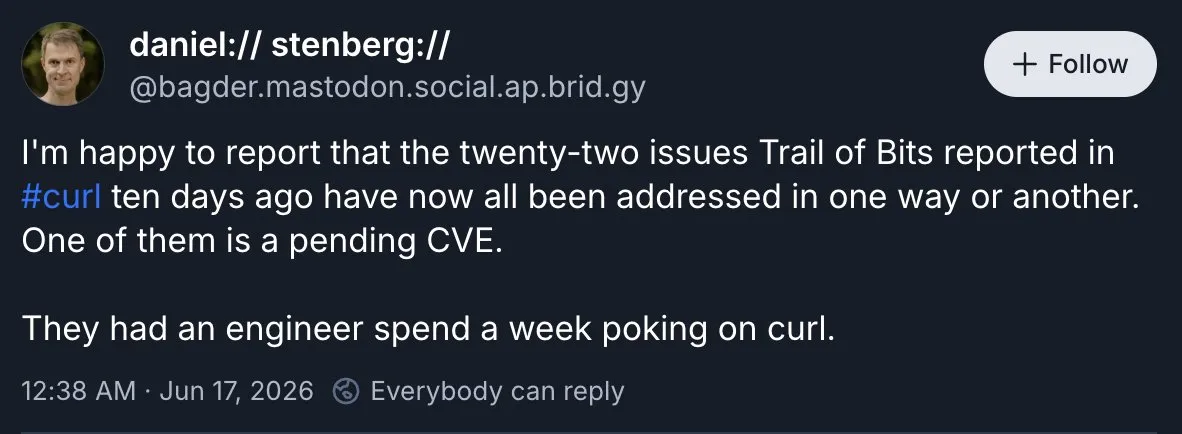
curl’s Daniel Stenberg, on the 22 issues one of our engineers found in a week. By his count, AI tools had already driven hundreds of curl fixes before this round.
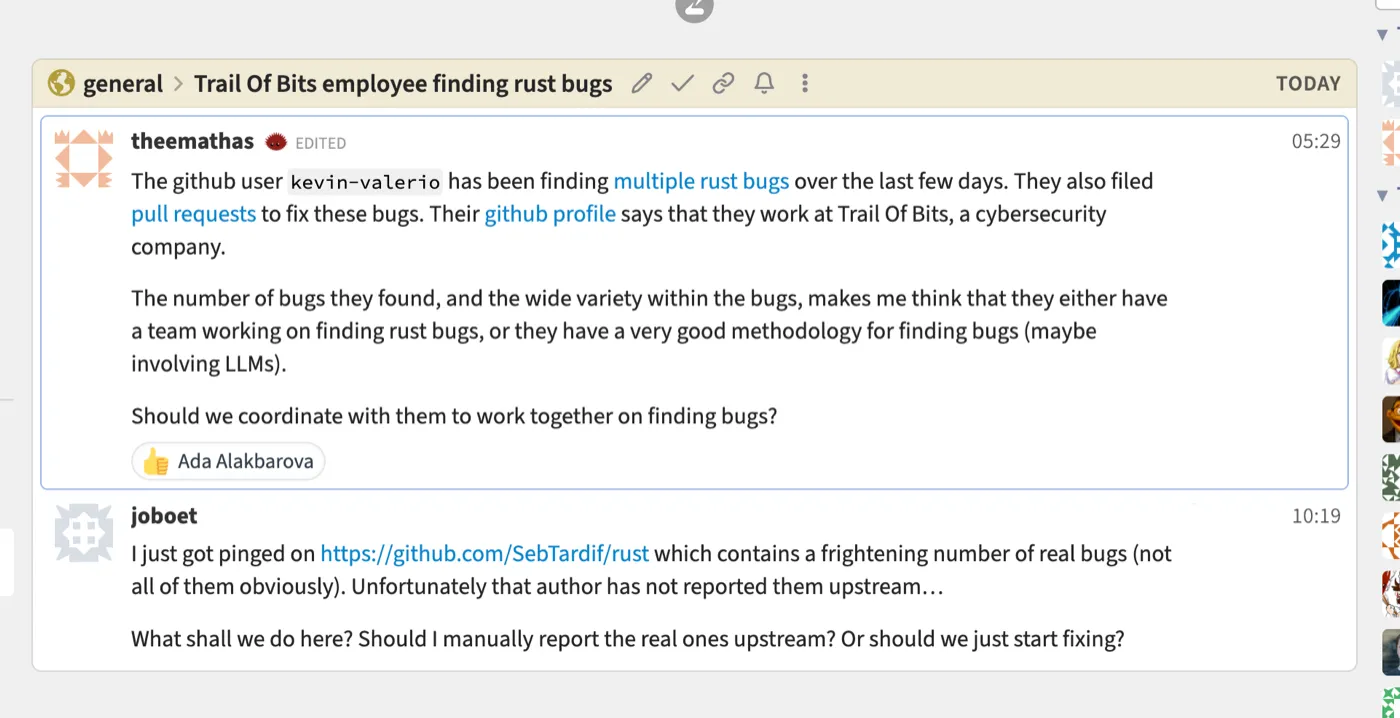
Rust’s maintainers assumed a team was behind the reports. Kevin Valerio filed them solo, with Codex.
Maintainers of critical open-source projects can apply to join.
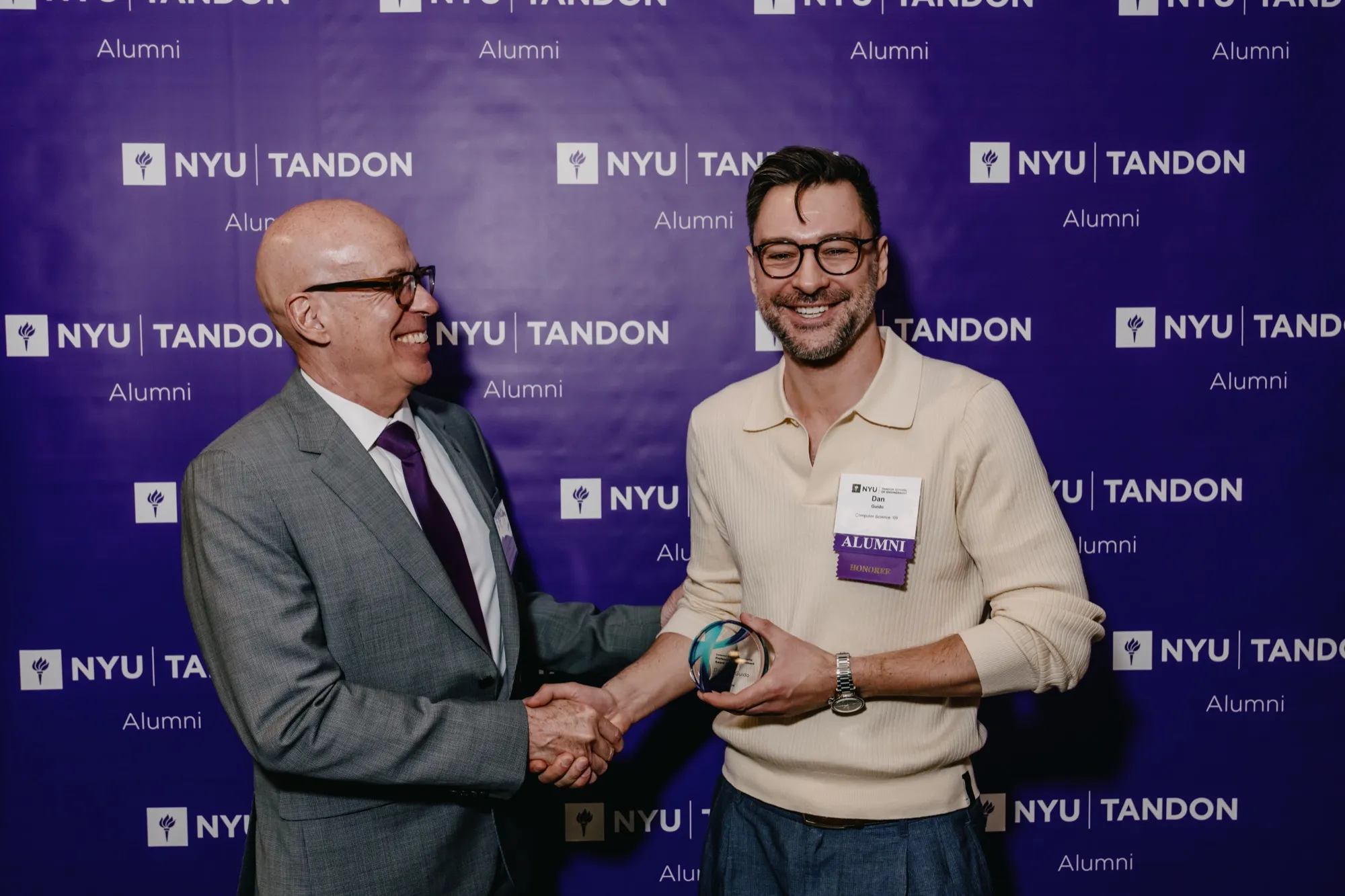
NYU Tandon gave me its Professional Achievement Award at the school’s first alumni summit. I taught graduate courses there before I had my own degree, then ran its security lab for years. The award is for the work I did outside the school, but it means more coming from a place I put that much into.
This award goes to Dan Guido for his exceptional leadership, innovation, and impact in the field of cybersecurity. As CEO and co-founder of Trail of Bits, he has built a nationally recognized firm at the forefront of security research and software assurance for critical technologies, leading major advances in areas such as cryptography, artificial intelligence, and blockchain security. Under his leadership, the company has grown into an industry leader known for technical excellence, with achievements including recognition in prestigious DARPA cyber competitions and a successful spin-out of iVerify, a mobile security tool designed to detect sophisticated spyware threats. Beyond the company, Dan has influenced the broader technology and cybersecurity landscape through his advisory work with startups, government agencies, and major policy institutions. His distinguished career reflects exactly the kind of significant contributions, industry leadership, and innovation that this award is meant to recognize.
NYU’s writeup covers the summit and the rest of this year’s honorees.
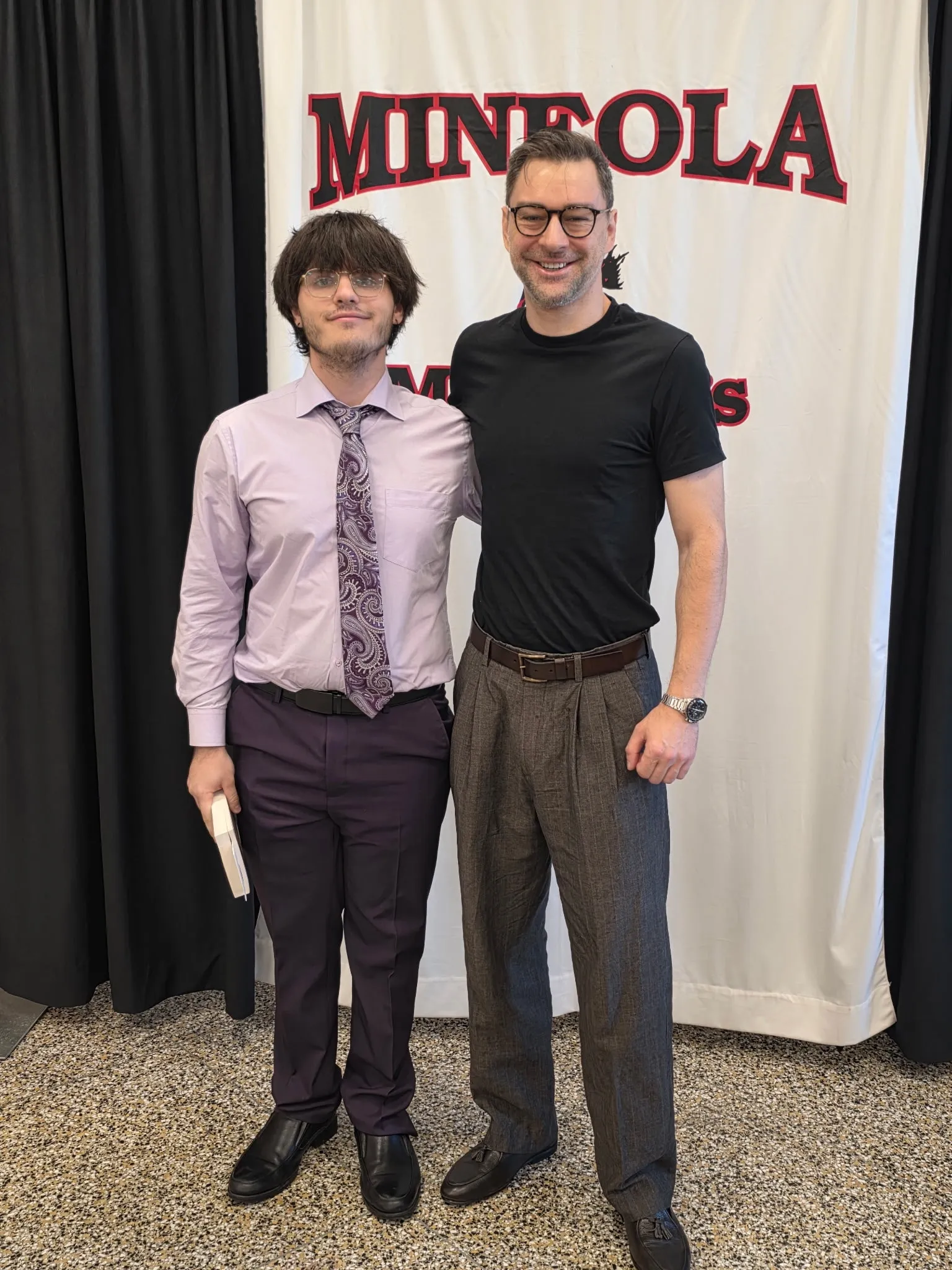
tl;dr Every year I give a Mineola High School senior $2,500 for teaching themselves to take systems apart. This year it goes to Richard Davidson.
I was the kid this award is for. At Mineola, I spent my free time taking the school’s systems apart, and the school’s answer was to ban me from the computers. I started the scholarship to recognize students who take that same initiative to figure out how things work. The backstory is in last year’s Trail of Bits post.
I’m also dropping the original name. “Unconventional Innovator” was the version that fit on a certificate. “Hacker Spirit” is what it actually rewards, so that’s what I’ll call it from here, and that’s the name on hackerspirit.org.
This year’s recipient is Richard Davidson. He scored well enough in CyberStart America to earn a scholarship into the GIAC GFACT cybersecurity fundamentals course, then worked through it on his own. He’s competed in the National Cyber League and the National Cyber Cup.
No teacher assigned any of this. It happens after school, off the transcript, in programs Richard found and signed up for himself. Nobody made him start, and that’s the part the award is for.
There’s a lot in here I haven’t talked about anywhere else: how Trail of Bits
survived eight months without revenue after the 2013 government shutdown, the day
we bought every 32xlarge EC2 instance on Earth for DARPA’s Cyber Grand Challenge,
an Amazon tech running through a Sydney data center to find us machines, and how
getting robbed in the DAO hack led us into blockchain security. We also get into
incident response at the New York Fed, hiring for mastery, and learning to become
a CEO.
There are four exchanges worth pulling out.
On how companies will have to adapt now that frontier models can do real offensive work (watch):
“It means that companies have to respond at machine speed to these intrusions, because that LLM is going to be seeking out all these little opportunities, these chinks in your armor, in order to further burrow itself into your company.”
On why North Korea keeps winning against blockchains (watch):
“What you see from them is they’re performing intrusions, assessing the environment they have access to, and on the fly writing novel tools to take advantage of it. They’re writing smart contract code. They’re writing malware. They’re doing things that are really quite sophisticated.
So yeah, I’m impressed. They did a good job. I was an attacker. I have to appreciate good game when I see it.
With the NSA or somebody else in the US, they’re going to have reams of lawyers. They’re going to pull out some huge book of Title 50, Title 10 stuff. They have so much restraint. North Korea and Iran don’t.”
On how Trail of Bits ended up in blockchain security (watch):
“So we all bought DAO tokens and then we all got robbed. And it was this funny light bulb moment when we were like, oh my God, did another hacker just steal money from us?”
“We take all comers. One of our most successful employees was a lot like me. It took me six years to graduate college. I had to go back for my final semester and finish physics one, discrete math, and linear algebra.
I was a smart kid that burned out, and I think a lot of people who are highly motivated and understand what they want to do in the world have a similar experience.
At Trail of Bits, the thing that binds everybody together is that we all want to be the best at what we’re doing. It’s team cohesion through competence.”
Use these timestamps to jump into the recording:
1:14 — What is Trail of Bits and how did it get started
6:49 — My upbringing and developing a passion for computer science and hacking
tl;dr A security tool that clients can’t run reliably won’t deliver its promised protection, no matter who recommends it.
In security we keep optimizing for completely solving the problem, when the bigger constraint is whether anyone can actually adopt the thing. Most security tools genuinely solve the problem they target but come at costs to install, configure, and live with that are unacceptable.
I picked up ACCORD, a framework for technology adoption,
from Jonathan Levav at Stanford in summer 2025. The version I learned has six
criteria:
Advantage: Is it better than what people use now?
Compatibility: Does it fit their existing habits, values, and tools?
Complexity: How hard is it to understand and use?
Observability: Can others see it being used and recognize its benefits?
Risk: What could people lose if it fails?
Divisibility: Can people try it on a small scale before committing?
I run startup pitches, internal research, academic proposals, and client recommendations through it.
A founder pitched me a tool for tracking data flows through AI systems to protect
against prompt injection. It would label tainted data so user data and prompts
could be kept separate from the rest of the system. But it required extensive
manual implementation and tagging. The system was brittle, and adoption was all
or nothing.
They wanted to partner with Trail of Bits for the credibility and trust we’d
earned with clients. We’d introduce the product and provide services to install
and configure it.
I declined because we’d end up asking clients to adopt a tool they couldn’t
manage. It was too complex to operate, would break in production, and wouldn’t
deliver the security benefits they wanted. Our introductions and installation
services wouldn’t solve those problems or change the ACCORD assessment.